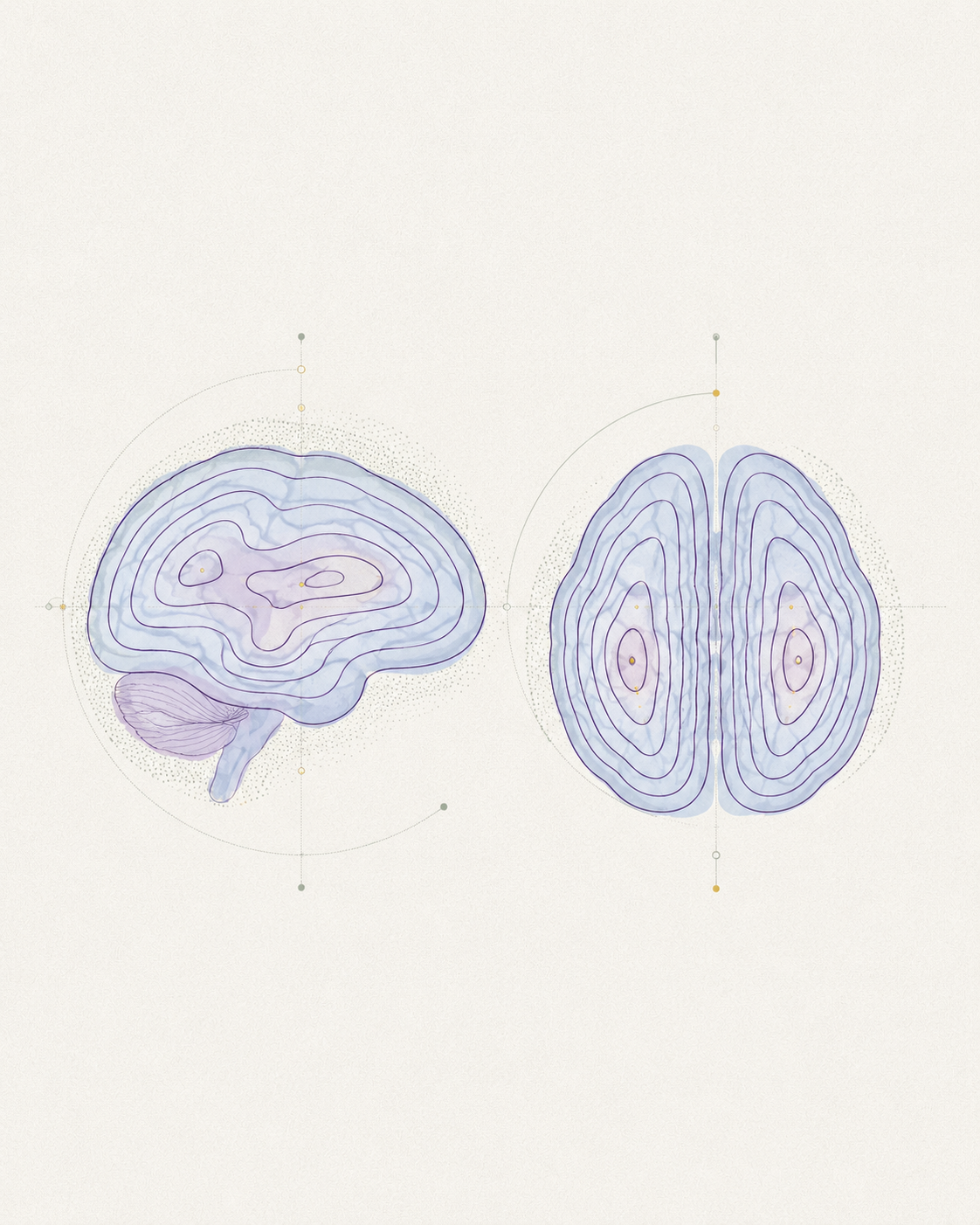
Medicine is full of labels. Labels are useful when they coordinate care, organize evidence, and help people access support. But labels are often too coarse for the biology underneath them. Two people can share a diagnosis while moving through very different biological trajectories. Two others can have different labels while sharing a mechanism that matters for research.
A health-state coordinate is Cytognosis's research answer to that problem. It is a position in a learned biological space, built from multimodal signals and interpreted with uncertainty. The coordinate does not replace clinical judgment. It helps researchers describe state and motion with more precision than a category alone can provide.
Five things a coordinate carries
The coordinate itself is only the beginning. A useful coordinate needs context. We treat every coordinate as a bundle of five elements.
- Position: an estimated location in a continuous health-state space.
- Trajectory: how that position changes over time.
- Baseline deviation: how far the current state appears from the individual's own prior pattern.
- Uncertainty: the bounds around the estimate, including missing or noisy measurements.
- Evidence traceability: the source signals and model assumptions that contributed to the output.
Why baseline matters
Population norms are blunt. They are often necessary, but they can hide the most important signal: a meaningful deviation from a person's own stable baseline. A value that looks normal in the population may be unusual for one individual. A value outside the population range may be stable and unremarkable for another.
Longitudinal modeling lets researchers ask a better question: is this state moving in a way that suggests a durable trajectory, or is it ordinary variation? That distinction is central to early research interpretation.
Why uncertainty must stay visible
A coordinate without uncertainty is too easy to overread. Measurements can be noisy. Modalities can disagree. Cohorts can be biased. Models can be confident in the wrong setting. We design outputs so that uncertainty remains attached to the coordinate instead of disappearing behind a clean visual.
That is especially important because Cytognosis is non-diagnostic. A coordinate should not be treated as a clinical conclusion. It should be treated as a research representation that can be reviewed, challenged, and refined as better evidence arrives.