A free, private, on-device AI companion built by and for neurodivergent people
Yar notices how you are doing, with your consent, and changes what it does for your day. It suggests; you decide.
In development. Yar is not released yet.
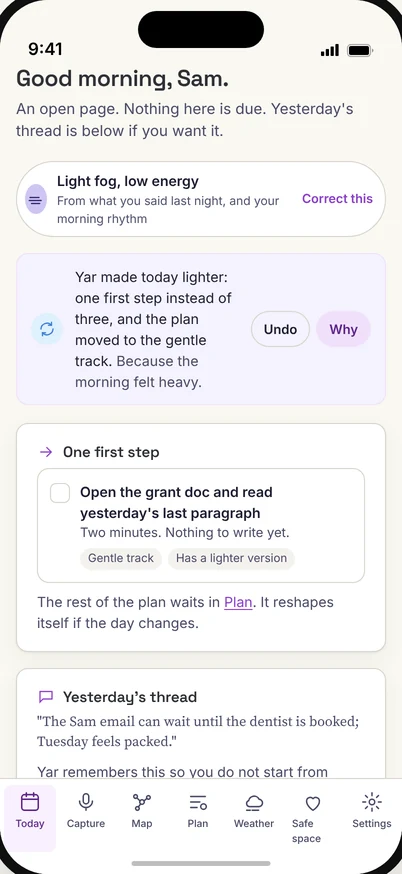
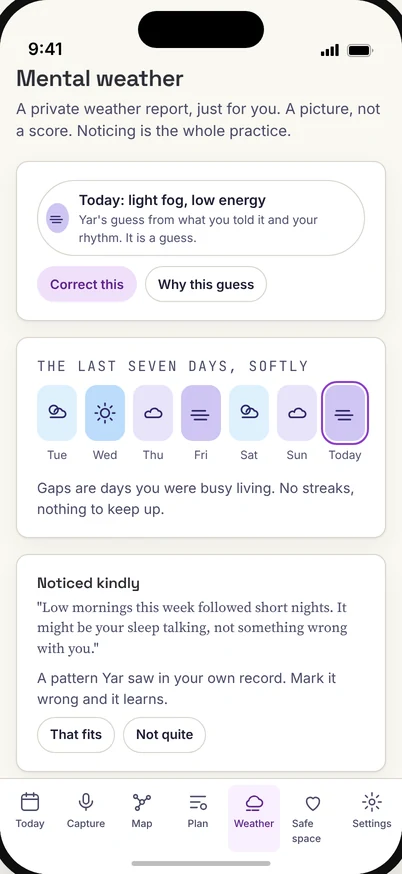
A guess you can see and correct, that changes your day.
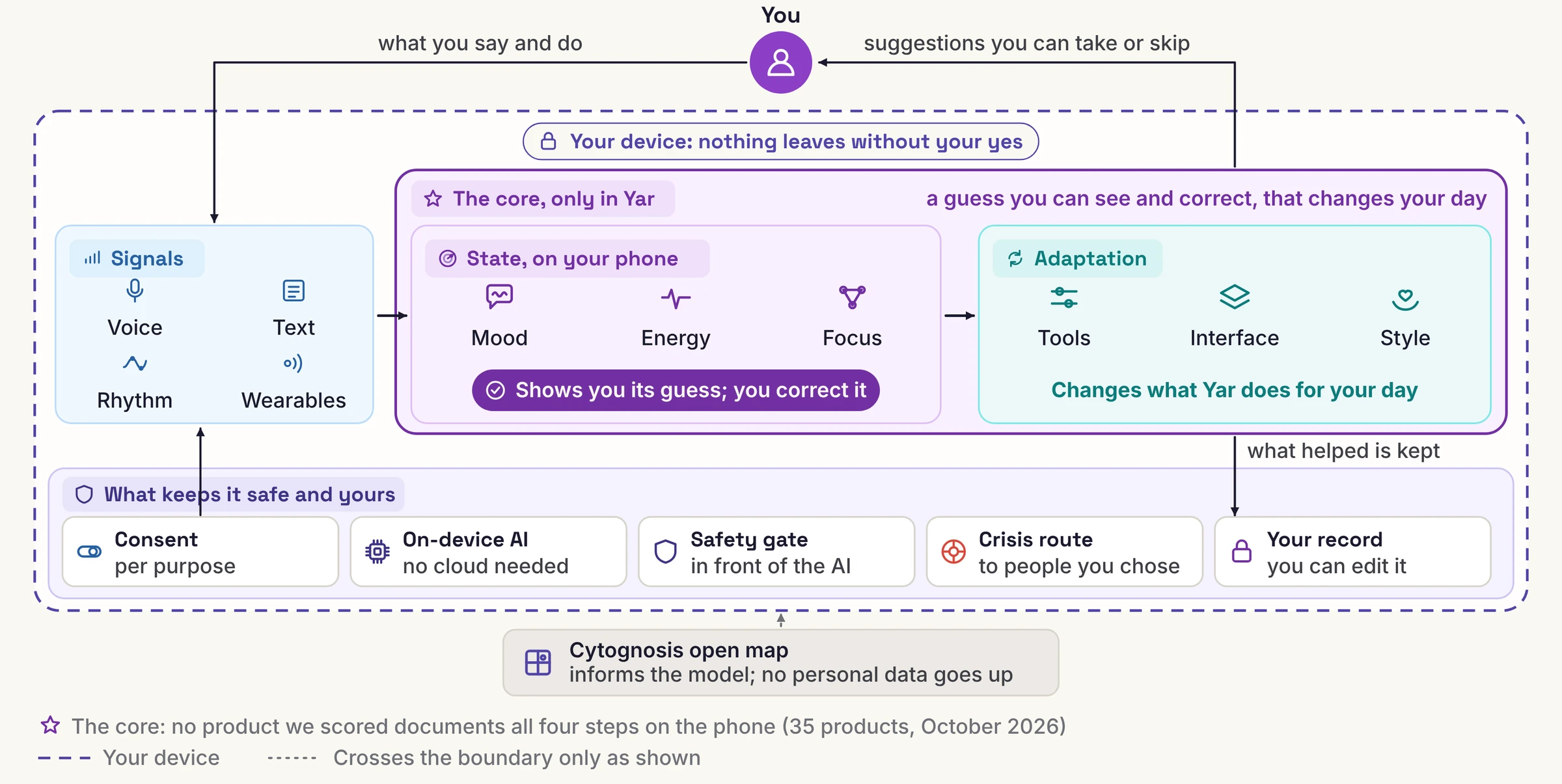
Yar shows you its guess about how you are doing, lets you correct it, and changes what it does for your day, with the AI on your own phone. Everything else supports that core.

How the core works: one loop, on your phone.

Four screens, four steps.
-
 1
1
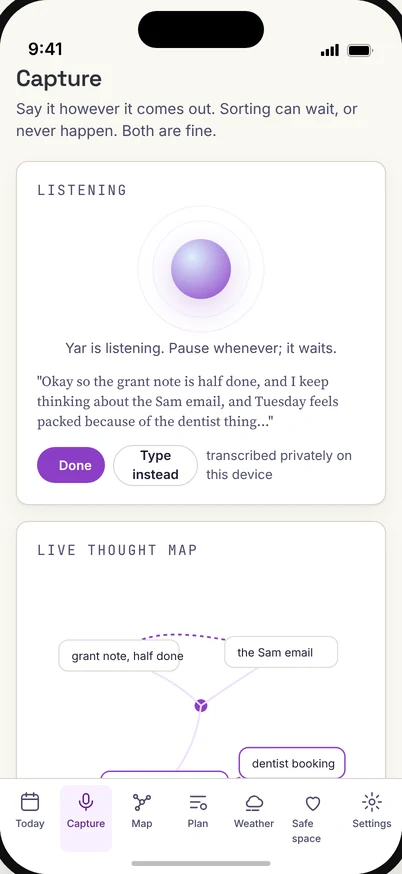
Capture
Your words become a map while you talk.
-
2
Mental weather
A guess you can see and correct.
-
 3
3
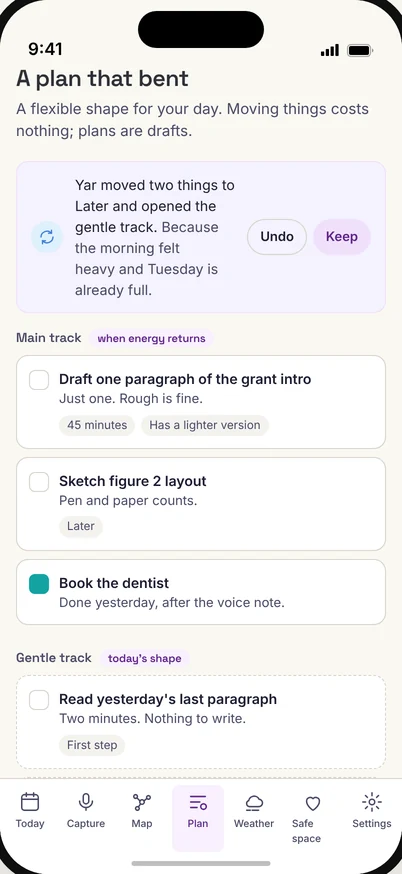
A plan that bent
Lighter today, with its reason and an undo.
-
4
Today
Yesterday’s thread, remembered.
Design mockups from the Yar app template. They show where Yar is headed.
Everything happens on your device.
Nothing leaves without your yes. A safety gate stands in front of every model call, and you can see, edit, or delete what Yar keeps.
Scroll sideways to see the whole picture.
Others do part of the loop. Yar closes it.
We read the public pages, app listings, and privacy policies of 35 products. Each group below does some of the steps; none we found does them all on your phone.
| Product group | Notices how you are | Shows you its guess | You correct it | Changes your day | On your phone |
|---|---|---|---|---|---|
| Planners for ND peopleTiimo, Structured, Goblin Tools | you tell it | – | – | when you tell it | some features |
| Energy, calendar plannersLifestack, Circadian AI, Motion | from wearables | partly | – | yes | one of them |
| AI companionsAsh, Wysa, ChatGPT | from your words | – | memories only | what it says | – |
| Trackers, platformsBearable, How We Feel, Apple | you log it | factors, some | – | suggestions | the record, some |
| Yarin development, by design | yes | yes | yes | yes | yes |
Scroll sideways to see every column.
-
Free, always
No subscription, no ads, no sale of personal data.
-
Private by default
It runs on your own device. Nothing leaves without your yes.
-
Suggests, never decides
Yar notices and offers. You choose, and every change has an undo.
-
By and for neurodivergent people
Diagnosed or self-identified, you are welcome. Built in the open.
Shape what Yar builds next.
Explore the feature map and score what would help you most, or join early access to try Yar as it develops.